.jpg?width=800&height=383&name=55331594717_a9a4d3fc0d_c%20(1).jpg)
data
nature
science

This post will cover the moth trap results for 2026 up to June - giving a mid year view of the site, what moths were recorded, and what the figures mean for the site this year.
As a cut-over peat bog, Brackagh is a site of particular importance given its status as an ASSI. It is also however in a precarious position of being degraded and lost to the wet woodland and fen. Several ecological models have been used to analyse the data and give us a picture of the health of the site from a lepidoptera perspective, and helping decide where conservation efforts need to be prioritised to ensure the site is effectively maintained.
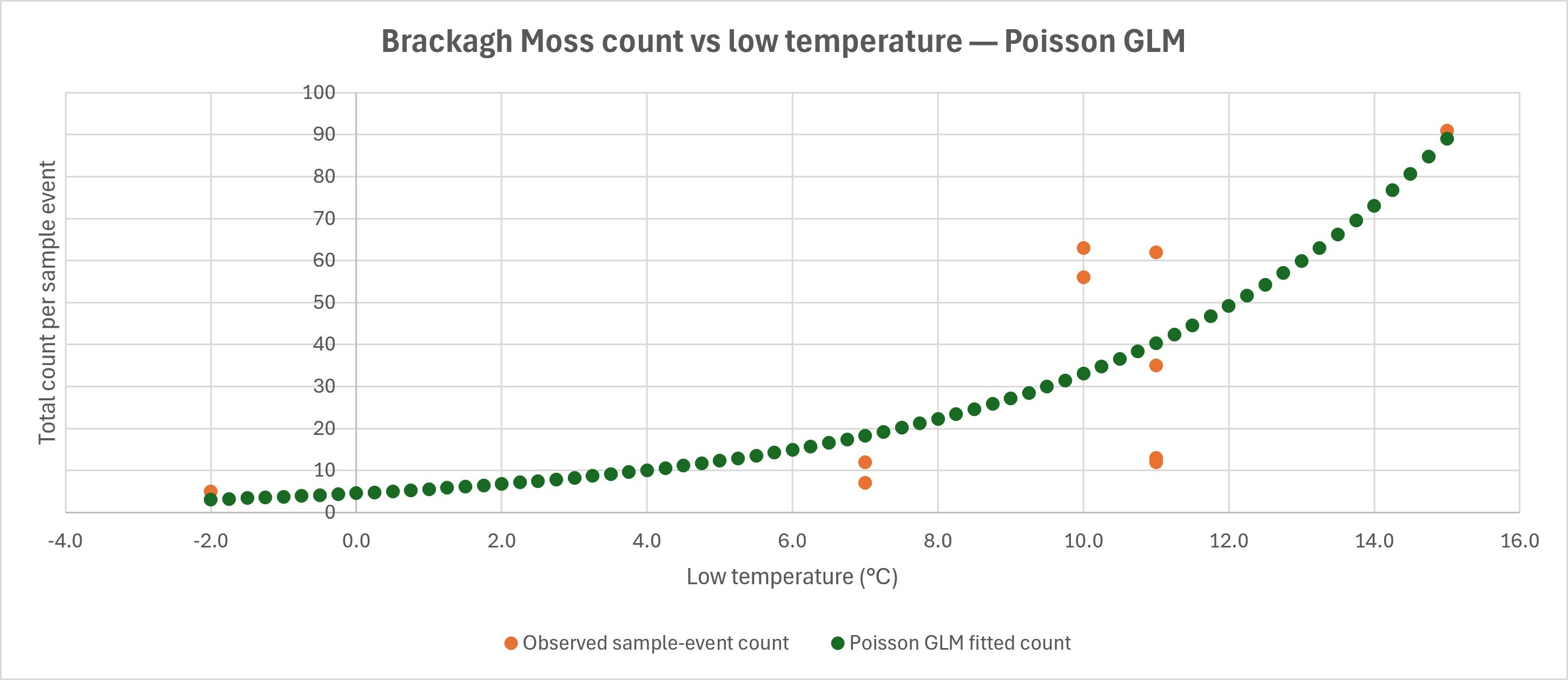
The data shows a positive relationship between low temperature and moth count at Brackagh Moss:
Bottom line: warmer nights tend to produce higher counts, but temperature alone is a weak predictor of individual events. The result is associative, not necessarily causal.
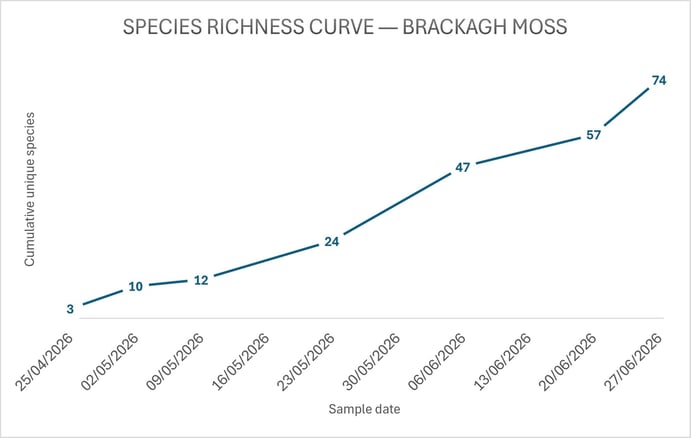
The Richness Curve shows us that species richness is still rising and has not plateaued for the last date recorded in June:
Conclusion: additional sampling at Brackagh Moss would probably discover more species; the current inventory is not yet complete.
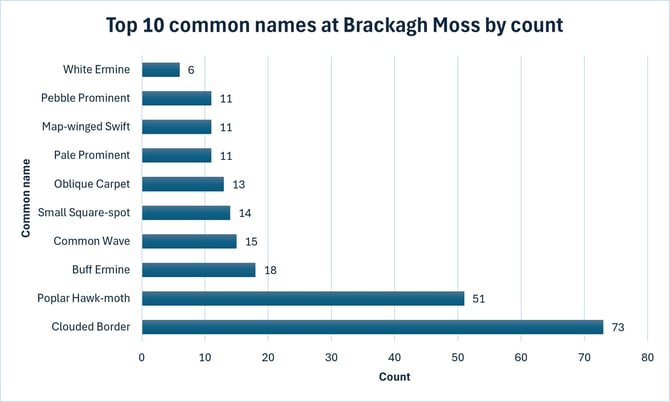
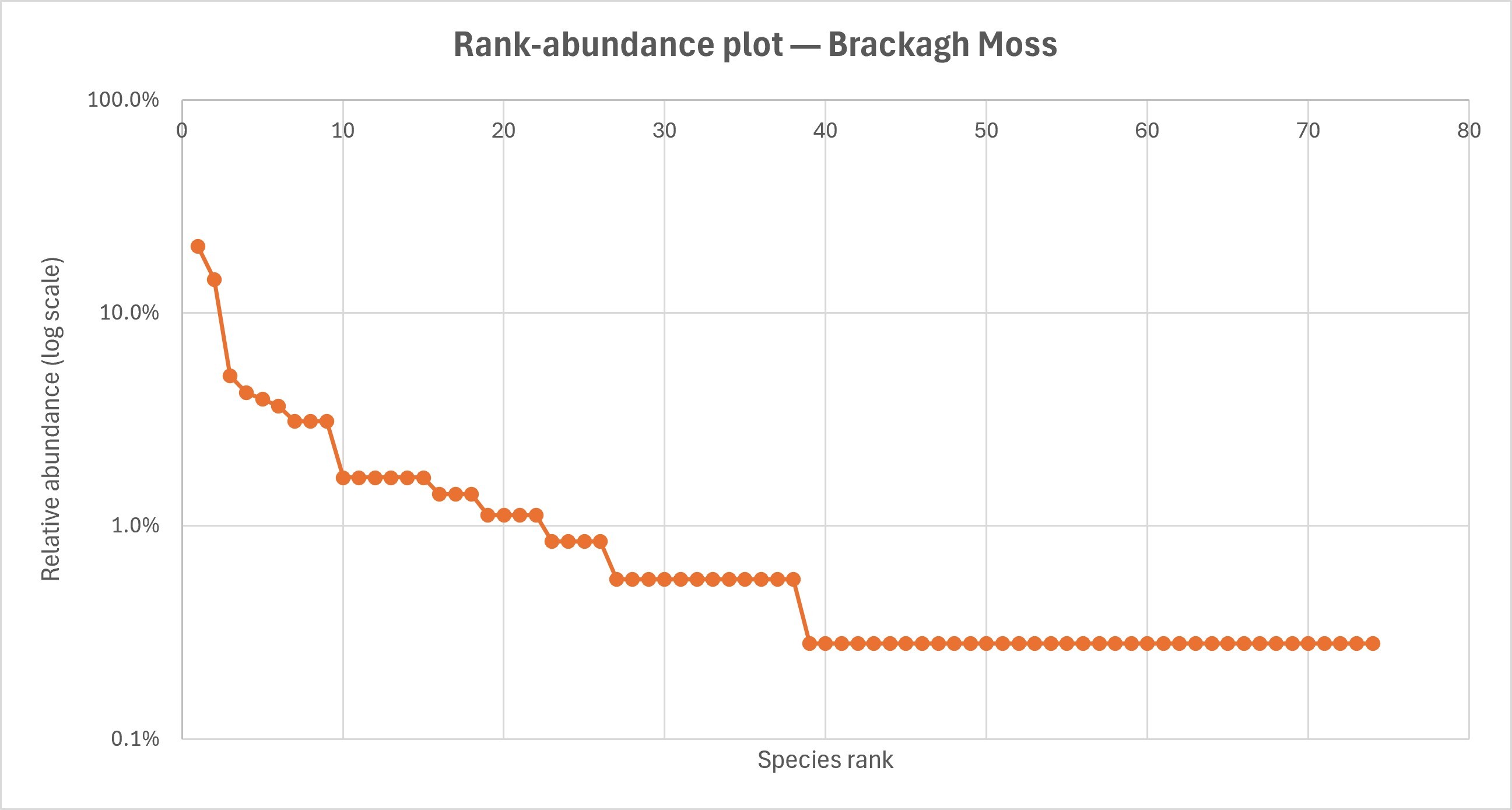
The Brackagh Rank Abundance plot shows a strongly uneven moth community:
Conclusion: Brackagh Moss has high richness (74 species), but relatively low evenness because a few species dominate while most are scarce:
Abundance-Rarity Pattern: The log-series mathematically dictates that species with one individual are always more abundant than species with two, which are in turn more abundant than species with three. The "singleton" category is always the modal class (the most frequent group size)
Dominance of a Few Factors: When a dataset fits this model well, it generally implies that the community structure is dominated by one or a few key ecological factors, preventing an even spread of populations
Ideal for Diverse/Undersampled Communities: The model is particularly useful for highly diverse assemblages (like insects in light traps at Brackagh Moss) where sampling captures many rare species but misses the total population size
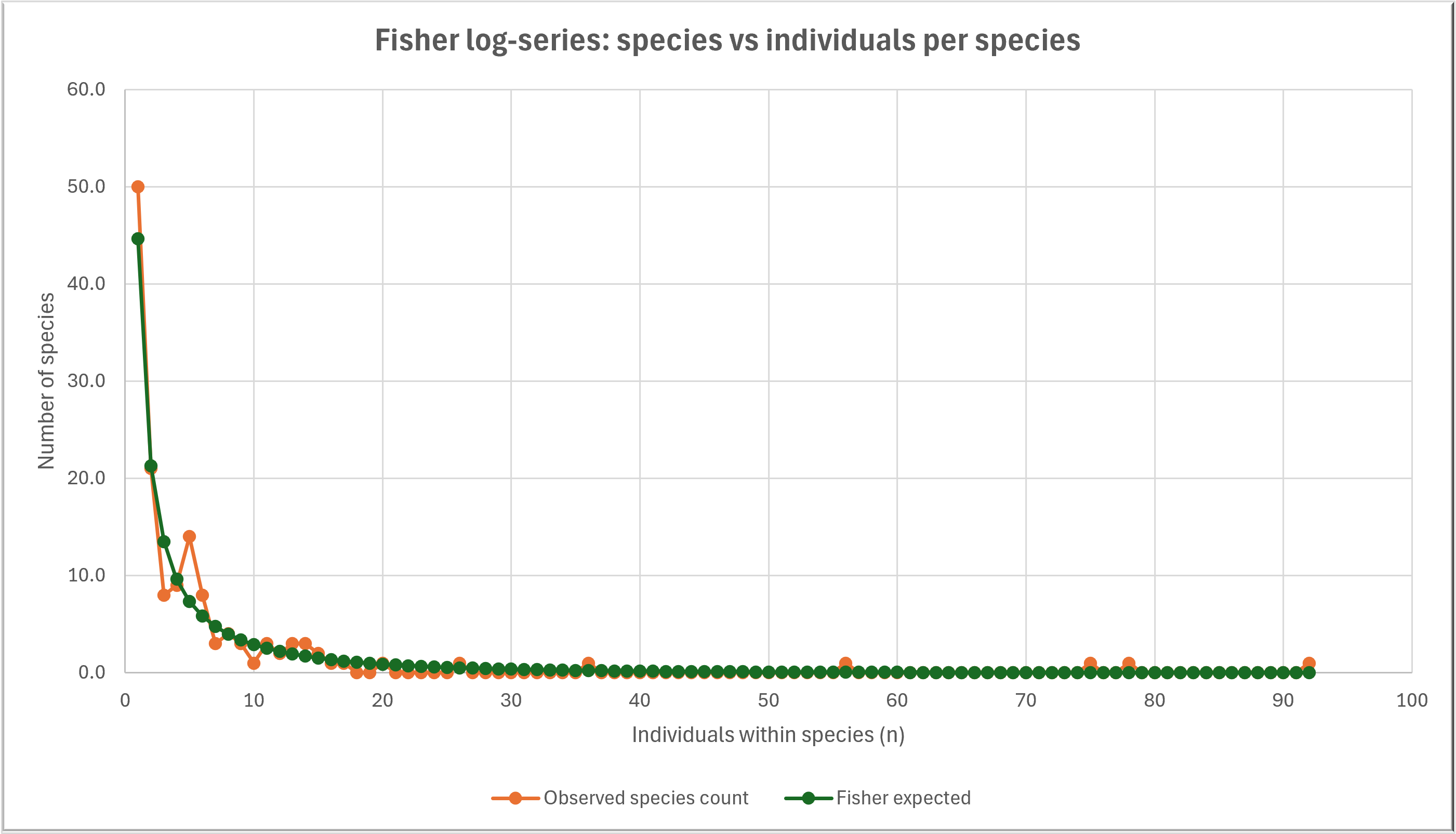
So as our curve fits the predicted curve very well (with a couple of expected outliers) - what does this tell us? The interpretation has to be in the context of a peat bog, and wet fen - and tells us that "community structure is dominated by one or a few key ecological factors, preventing an even spread of populations". What are these factors?
In the context of a peat bog, these ecological factors (often referred to as niche filtering) fundamentally shape the diversity curve:
Three ecological factors may explain Brackagh Moss’s diverse but uneven moth community:
Brackagh Moss supports a species-rich moth community: 74 species and 356 individuals were recorded there. However, the community is uneven—Clouded Border and Poplar Hawk-moth comprise 34.84% of individuals, while many species are scarce. Since the richness curve is still rising, more species probably remain undetected - let's see what the rest of 2026 brings!
Conservation priorities