macro photography
mycology
fungi

My fungus photography shoot at Clare Glen in County Armagh brought together a varied set of woodland subjects: a moss-framed bolete, small brown mushrooms, slender white clubs, porcelain fungus and clusters of beech jellydisc.
For this outing, my equipment was a Canon R7, Sigma 105mm macro lens, Godox V1 flash and Cygnustech diffuser system. The photographs bring together two parts of my DGPix nature photography: looking closely at the subject and keeping its surroundings part of the story.
Clare Glen is a woodland walking destination beside the River Cusher near Tandragee, County Armagh. The council's Clare Glen page provides a starting point for planning a visit.
For this photographic account, the site's importance comes into focus at a smaller scale. Moss, decaying leaves and wood feature throughout the images. Those materials give the fungi a setting and remind us that a woodland includes much more than its living tree canopy. A wet woodland like this provides a great array of fungi and slimes to photograph during peak season, remaining damp where other sites may dry up between bouts of rain.
The pictures are a record of subjects from one shoot, not a complete fungal survey or a measure of the site's conservation condition. Keeping that distinction clear is part of the approach explored in my article on biological recording.
The names here follow those in the Fungi of Temperate Europe, including their limits. Galerina and Mycena remain at genus level, while the bolete retains its broad Xerocomus chrysenteron sensu lato label. A photograph should not be made to support a more precise identification than the evidence allows.
My Laccaria microscopy article illustrates how microscopic observations can add information beyond the finished photograph. This Clare Glen account is about photography and observation, not advice on identifying fungi for consumption!
The bolete is labelled Xerocomus chrysenteron sensu lato. Here, “sensu lato” means the name is being used broadly. This group also includes bubalinus, cisalpinus, declivitatum and porosporus; Without microscopic and further staining investigation, this one will remain aggregated.
Visually, the brown cap has a finely textured, cracked surface, while the stem carries reddish tones. Green moss surrounds the fruiting body, giving the image both colour contrast and a clear sense of its immediate setting.
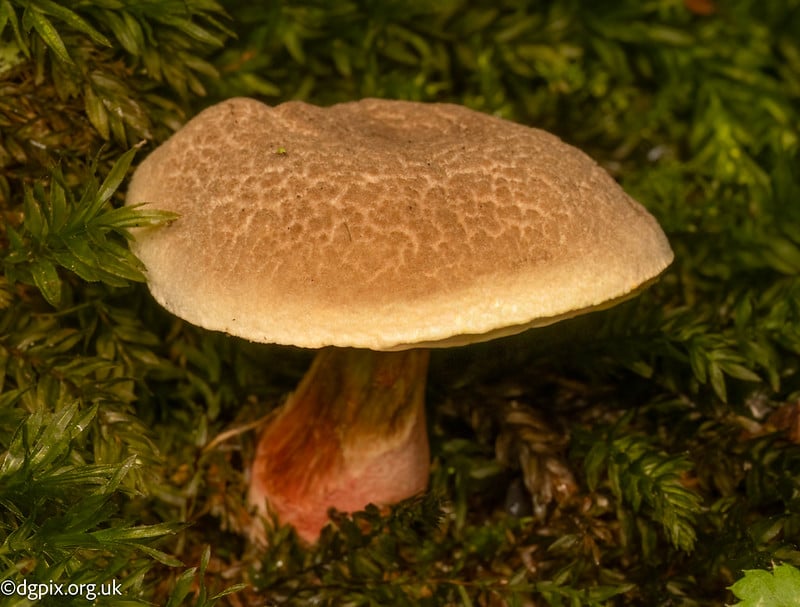 Photograph 1: Xerocomus chrysenteron sensu lato, photographed among moss at Clare Glen. The broad cap, textured surface and reddish stem provide the main points of interest.
The Galerina features ochre-cap which can appear slimy to the eye. Its cap margin, slender stem and visible ring offer several details to explore, while the moss and wood frame the subject for the photograph.
The background is softly blurred, allowing the mushroom to remain prominent without removing its woodland context. It is a useful example of how a simple composition can hold several different textures. I used a 22-image focus stack to produce this image and keep the background from being distracting.
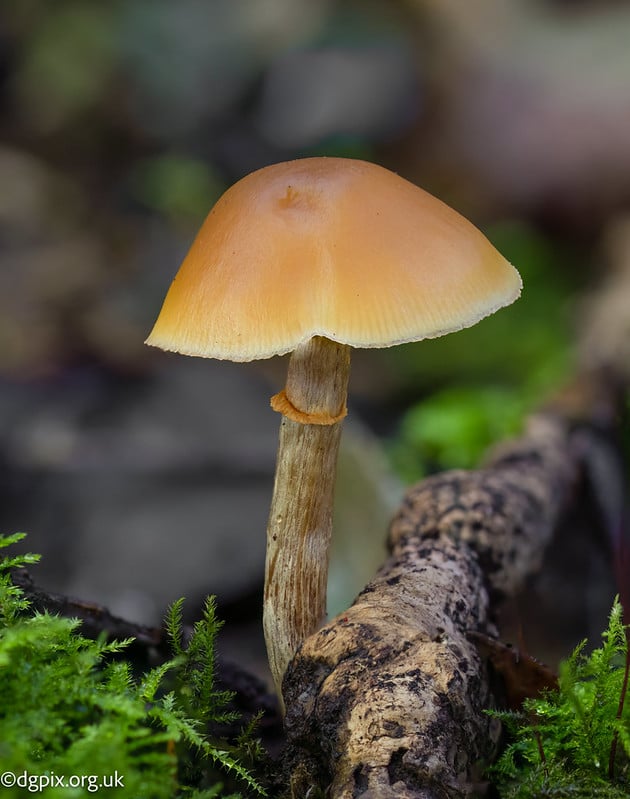
Photograph 2: Galerina species with an ochre cap and ringed stem beside a twig and moss.
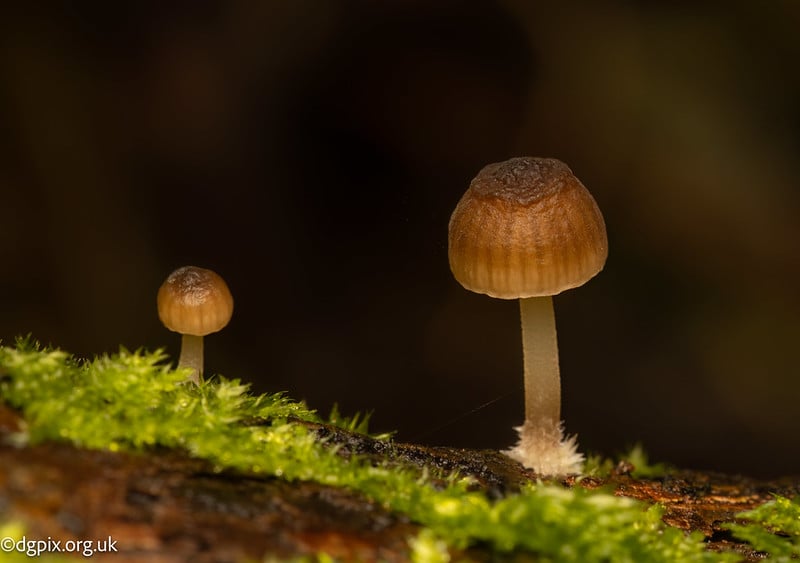
This Mycena shot was also a focus stack of 12 images, bringing the second mushroom into focus to create depth. The smaller mushroom gives the composition a second point of interest. I used diffused flash in this shot to clear the background of clutter and light. This remains a Mycena species record, I didn't take any samples to identify further under the microscope.
For a different fungal subject associated with small Mycena mushrooms, my Spinellus fusiger article explores a separate encounter.
Photograph 3: Two Mycena fruiting bodies on mossy wood, with brown caps, slender stems and a dark background.
This image of Clavaria falcata shows the two pale, upright clubs among brown leaves, a typical setting that you would find this species. Their narrow shapes offer a contrast to the capped mushrooms elsewhere, and the colouration works well against the poorly lit woodland floor.
The taller and shorter fruiting bodies create a simple pairing. Small surface marks remain visible, while the surrounding leaves provide scale and context without needing to dominate the picture. A simple 3 shot stack was required to ensure all was in focus. Form is one reason fungi make such varied photographic subjects. Microscopy was carried out to ensure correct species ID on this one, as it is a species I hadn't come across before:
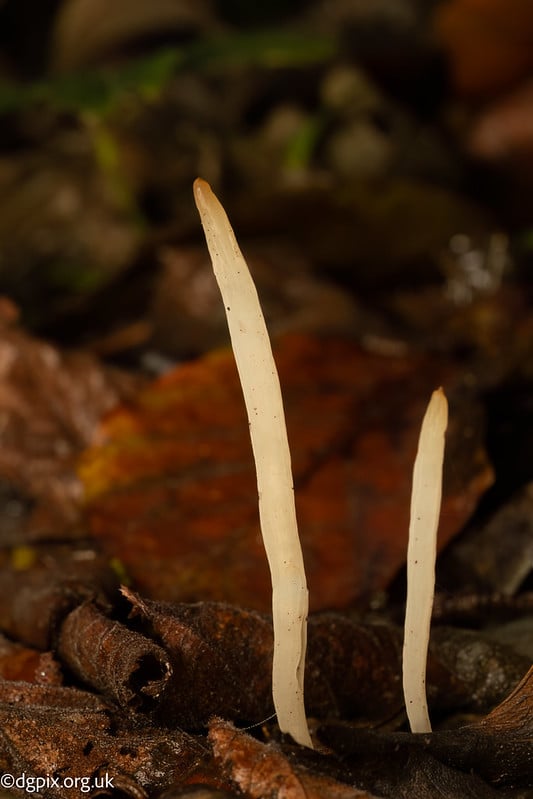 Photograph 4: Clavaria falcata, as labelled, with two slender white clubs rising through woodland leaf litter.
Porcelain fungus, Mucidula mucida, is also widely encountered under the name Oudemansiella mucida. Its association with beech wood and its translucent, glossy cap are described in many mycology accounts. It is one of the most attractive capped mushrooms to see this time of year, with the white glossy texture catching the eye.
The two photographs show contrasting forms. One has an open cap with visible gills and a stem ring; the other shows a pair with rounded caps. They make a useful comparison of shape and surface detail without needing to infer a precise age.
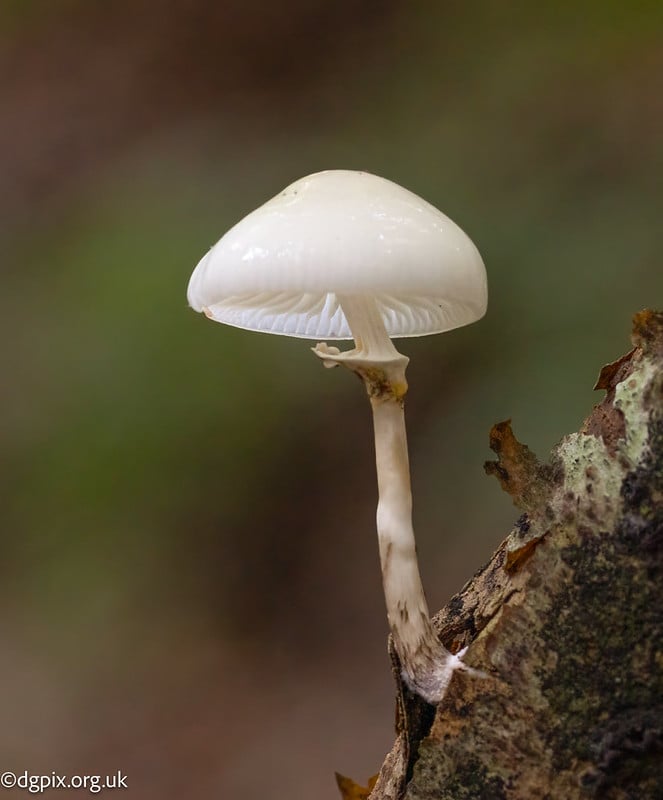
Photograph 5: A single porcelain fungus with a white cap, visible gills and stem ring, growing from wood.
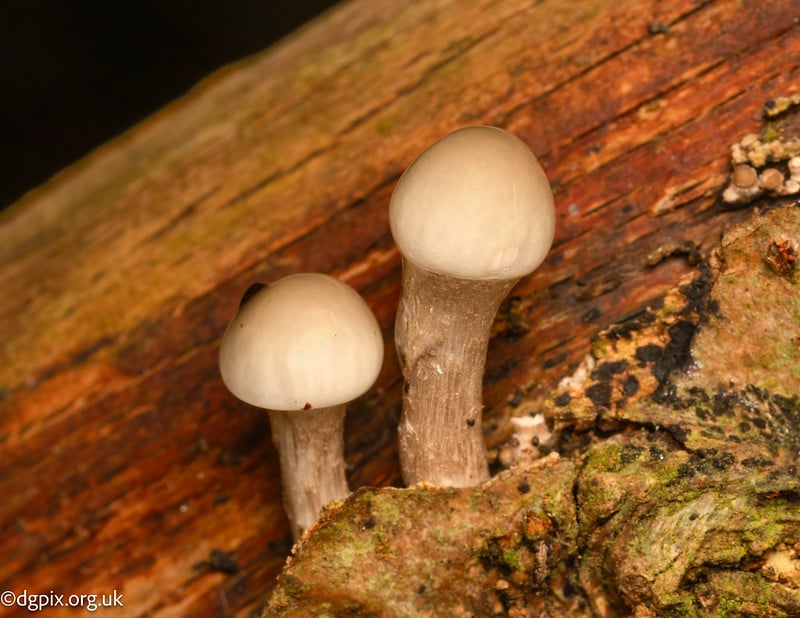 Photograph 6: A pair of porcelain fungus fruiting bodies with rounded caps against warm-toned wood and bark.
Beech jellydisc, Neobulgaria pura, forms gelatinous, pinkish-ochre fruiting bodies on fallen broadleaved wood, particularly beech. The First Nature description explains how their shape changes as neighbouring fruiting bodies press together.
The photographs show that contrast: more separated cups in one frame and a densely crowded cluster in the other - both make intersting images in different ways. Glossy surfaces, rounded edges and small highlights give both images a very different character from other fungi.
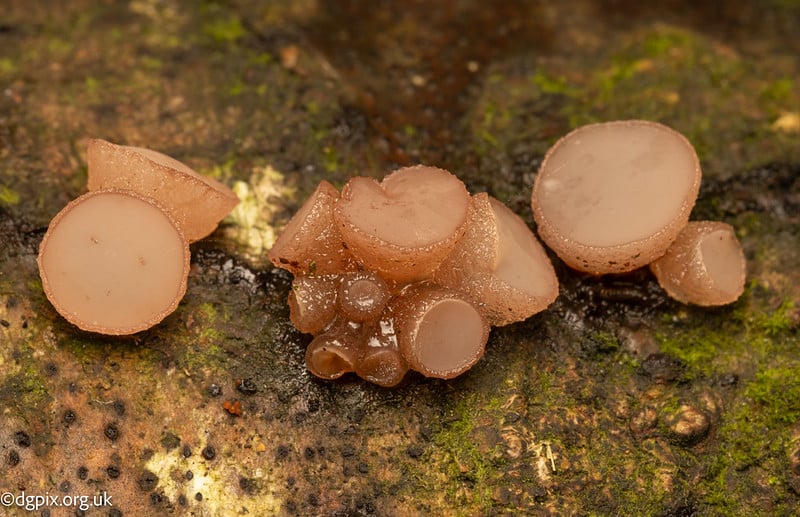 Photograph 7: Beech jellydisc cups spread across wood, showing pale centres and translucent-looking margins.
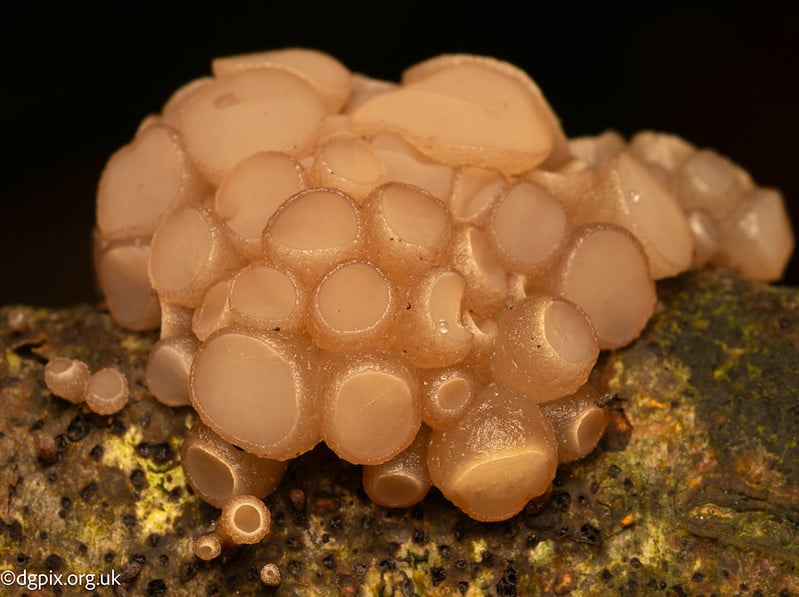 Photograph 8: A crowded beech jellydisc cluster, with overlapping cups and small highlights revealing its surface texture.
My camera-and-lens combination for this shoot was the Canon R7 and Sigma 105mm macro lens. The macro lens provides the close-focusing capability needed to make small subjects and fine structures prominent in the frame, and although an older lens, it is still the workhorse of my setup.
At close range, focus and viewpoint need careful attention. You can prioritise a cap edge, gills or the surface of a jellydisc, then judge how much surrounding detail helps the picture. More magnification is not automatically a more informative composition.
The lighting equipment for the shoot was a Godox V1 flash and Cygnustech diffuser system. The flash supplies additional light; the diffuser modifies how that light reaches the close-up subject, getting rid of shadows and softening the light to a more appropriate level. In come instances, it can create a black background where you want the subject to really stand out.
Softness depends on the apparent size of the illuminated source relative to the subject, as well as its position. A larger effective source close to a small fungus can give gentler shadow transitions. A round flash head alone does not guarantee soft light.
Glossy porcelain caps and jellydisc surfaces make highlight control particularly important. When setting up a similar system, check bright areas, shadows beneath caps and the effect on the background. Adjust light position and output rather than assuming that diffusion eliminates every reflection.
Responsible fungi photography means putting habitat care ahead of a cleaner composition. Avoid moving fruiting bodies, stripping moss or rearranging deadwood simply to improve a frame, and check the ground before placing your knees or equipment.
The Clare Glen images show how much of the setting can remain in the photograph: twigs, leaves, moss and bark all contribute. Related woodland subjects appear in my Spectacular Rustgill account, but the lesson here is straightforward: look closely and leave the subject's surroundings intact.
No. Available light can be useful when it suits the composition and exposure. A flash and diffuser provide another way to control illumination. For this shoot, my lighting equipment was a Godox V1 paired with a Cygnustech diffuser.
Not always. A photograph can omit important features, and additional evidence may be needed. Here we have retained the broader labels used for the Galerina, Mycena and bolete photographs here. Do not use this article or its pictures to decide whether a fungus is safe to eat.
Include the features that serve your purpose: shape and light for a portrait, or additional views and habitat notes for a record. At DGPix we try to brings those interests together, while keeping the distinction between an attractive photograph and a fully supported identification clear.
Check out this post from our Fungi Photography Workshop to see how these techniques were put into action